Showing posts with label Gardening. Show all posts

Thursday, May 24, 2012

My First Foray Into Wild Edibles

Every year when we put out our garden there is this certain weed that absolutely wants to take over. Last year we put straw down, which made a remarkable difference. We are going to do the same this year - probably this weekend. My husband has tilled in between the rows in the meantime to keep the weeds under control. But, this weed is still cropping up in the rows where our veggies are growing.

Then, a few days ago I  read this blog post from New Life on a Homestead about a common garden weed. MY common garden weed. Turns out that it isn't a weed after all. It's actually a super food called purslane. Go figure. 

I'm starting to realize that many of the plants that we consider weeds are actually some of the most nutritious foods on the planet. 


Take the lowly dandelion, for instance. That little plant is the nemesis of every man who desires a green lawn in the nation. But, it's actually very good for food. It's leaves can be eaten raw in salads or cooked many different ways. It's roots can be roasted and ground up and brewed as coffee. The flowers are also edible and are supposed to be a favorite when battered and fried. Though I've never eaten (or drank) it, I hear it is really yummy. It's also a powerhouse of nutrition that is fantastic for your liver, among other things.

But, we're talking about purslane today...


(from plantphotos.net)

This is what www.plant.photos.net says about purslane:

...also called Summer Purslane - purslane usually grows spread out flat on the ground. It can be found growing in almost any unshaded area, including flower beds, corn fields, and waste places. Purslane can be found growing in cold climate areas (e.g., Canada) as well as warm areas (e.g., the Caribbean).
Medicinal Uses:

Verdolaga is also valued in Latin America for its medicinal properties. Purslane contains more Omega-3 fatty acids than any other leafy vegetable plants, and may have positive effects on the brain and may aid in such conditions as depression, bipolar disorder, Alzheimer's disease, autism, schizophrenia, attention deficit disorder, hyperactivity and migraines. For other medicinal uses see: http://www.ansci.cornell.edu/plants/medicinal/portula.html#efficacy

American Indians used the plant as a poultice for burns, juice for earaches, tea for headaches and stomachaches.

Pretty cool, eh?

It's also an excellent source of vitamins A, C and E and the essential amino acids. So, I figured that I needed to try this wonder food. Crab cakes were on the menu for the night and I don't have any of the parsley that I usually put in it, yet. So, I thought it would be a great night to try the purslane. I went out the garden and pulled some of it, washed it really well in water and then spun it dry in my salad spinner.  


Since it can be eaten cooked or raw, I tasted one of the leaves. It has a very mild, but tasty flavor. It is supposed to be very similar in taste and consistency to watercress, but I've never eaten it so I can't vouch for that fact.
For my crab cakes, I simply cut the roots off and added the amount I needed to the food processor, stems and all. They're edible, too. Next, I added the rest of my ingredients to the food processor to finish chopping and mixing everything together.

Evidently, purslane is also a very popular salad green in Europe. Considering we were having salad with our dinner (and I've been buying the el cheapo bagged iceberg lettuce lately) I picked off the leaves of some more of my purslane and added to the salad mix to bump up the nutritional value of my otherwise pretty nutritionless bagged salad.


Not only is it tasty, but it's pretty, too. :-)


All in all, I really liked the purslane and will definitely use it again.
You probably realize this, but I'm going to mention it anyway. Don't eat wild edibles from places that are likely to have been sprayed with pesticides or that grow too close to the road where they would be covered in exhaust fumes. I felt confident using the purslane from my garden because we don't spray. We've actually found that our garden seems to do better than most people's in our area and I think it's because we leave it alone and try to build the soil quality every year. Healthy soil makes for healthy plants.
I'm amazed at how many wild edibles that we have around us and are clueless about. I would really like to start learning more about them. It just so happens that Wild Cards is a deck of cards that has pictures and information on 52 different wild plants that you can eat. It includes information on where each plant is found, how to cook it and its medicinal uses. I really need to get one of those decks.
So, tell me - have you ever eaten weeds?

I'm sharing this post with Wildcrafting Wednesday.

* UPDATE: I have had a couple of people tell me that the link to the Wild Cards took them to an, um, unsavory website. I apologize for that. On my Mac it took me right where it was supposed to. In an effort to fix the problem I changed the link. Please, let me know if it is still not working right and I will just remove it altogether and you can just google it for yourself. ;-) Thanks, y'all!

Thursday, November 3, 2011

Lemon Balm Tea

In yesterday's post I mentioned a few of the ways that I use my herbs.  Today I want to share one of those ways with you.  I'm going to show you how I make lemon balm tea.  


First, let me share a bit about lemon balm with you.  This excerpt is taken from the e-book "Healing Herbs" by Rosalee de la Foret.

Lemon balm is a highly aromatic plant that is easy to grow in your garden. Like many mints it has a variety of uses and is generally safe for all ages. It also tastes wonderful, making it an easy remedy to get down picky throats.

Children seeking comfort from the pain of teething can use lemon balm as a tea or can chew on a washcloth soaked in tea.

Like many mints it is an aromatic digestant that can be used for indigestion, gas, bloating, and other digestive complaints.

Lemon balm is antiviral and a relaxing diaphoretic, making it an ideal choice for colds and the flu, especially when accompanied by a fever. It is often combined with St. John’s Wort, both topically and internally, to relieve cold sores. Because both of these antiviral herbs are relaxing nervines they make an especially beneficial pairing for these stress-related sores.

Lemon balm’s calming abilities are especially suited for tissues in an excited state such as hyperthyroidism. It is often paired with bugleweed (Lycopus spp.) and motherwort (Leonorus cardiacus) for hyperthyroid conditions with heart palpitations. Because it is often used for hyperthyroidism, some caution those with a hypothyroid from using too much of it.

If you’re feeling overly stressed with a go-go-go-go mentality, a daily lemon balm infusion can help you to slow down and unwind. I like to pick lemon balm just before it flowers, which is usually when the temperatures are nice and toasty outside. 

Ok, now for my disclaimer.  I love lemon balm.  But, as you just read it is a part of the mint family.  In case you don't know what that means - IT IS VERY INVASIVE.  I actually have spearmint growing as well, and lemon balm makes spearmint look like a wussy in regards to it's invasive tendencies.  I knew nothing about it when I planted it other than Isaac thought it would be good to have.  Note here - research before you go planting something you know nothing about.  That one little lemon balm plant that we put in the front flower bed has sent runners under the ground all the way into the back yard.  It wants to take over everything.  Having said that, I would still grow it, I would just grow it in a pot or in a separate bed with deep boundaries to keep it in one spot.  Hind sight's 20/20...

So, here's my favorite way to use this lemony herb of goodness.

Pick (or cut) your lemon balm and wash it in cool water.


Stuff it into a quart sized mason jar while twisting and bruising the leaves.  There is no need pick the leaves from the stems.


Next, fill the jar with boiling water to cover the lemon balm.  Then, press and crush the leaves with a wooden spoon.


Once the leaves have been crushed, cap the jars and wait for them to completely cool.


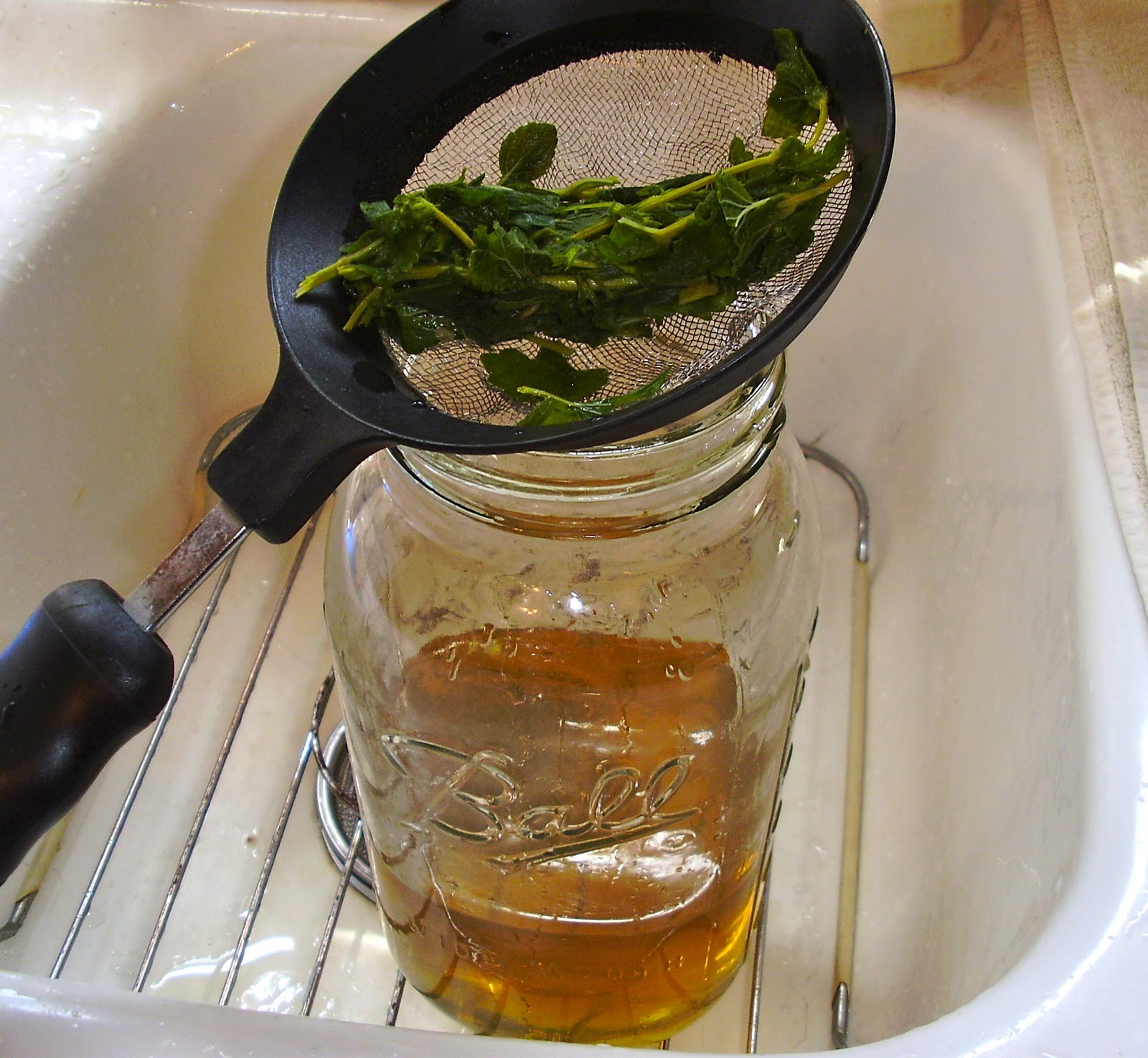
After the tea has cooled, strain it into a different container.  I strained my quart jars into a half gallon mason jar, but you can use a pitcher or anything you have on hand.


The tea you now have is very concentrated.  You want to dilute it by at least half.  In this case, I poured the tea off of my quart sized jar into a half gallon container and finished filling it up with cold water.


It's a matter of taste at this point.  You may like your tea a little weaker.  Depending on how strong my first batch of tea is, I may dilute it by thirds or even quarters.  

You can add a little honey or simple syrup it you like it sweet.  Or if you really want to play up the lemony flavor, you can add an extra dash of lemon juice.

With the rest of the tea concentrate I had left, I poured enough concentrate to make a half gallon of tea at a time into freezer bags and popped them in the freezer for a quick way to make tea each time I had a hankering for some.  Just make sure you don't skimp on quality bags for this like I did.  They leak everywhere leaving all of your hard work a waste.  Whoops...

Since we're not drinking soda anymore we're always on the lookout for a healthy beverage alternative.  You know, sometimes you're just not in the mood for water. :0) Lemon balm tea just fits the bill. 


I'm linking this post to Simple Lives Thursday.

Friday, July 15, 2011

Tattler Reusable Canning Lid Review

I mentioned yesterday that I did my first round of canning for the season recently.  This canning session was a little different than most for me, though.  I had ordered some Tattler reusable canning lids.  The reusable canning lids are BPA free and consist of a flat white lid with a rubber ring that goes between it and the jar.  They have received great reviews and are supposed to be something that I can use for decades.  Y'all, buying lids every year can really crank the cost of canning up.  These are kind of pricey up front, but will be much more economical over time.

I had been anxiously awaiting my first go 'round with them.  I only ordered 3 dozen to begin with because I was unsure of how they would work for me.  I was a little uncertain about them having 2 pieces and not making the "pop" that assures me that they sealed properly.

I plunged head-first into canning my first seven quarts of green beans with the Tattler lids, following the the directions exactly.  Which, incidentally isn't any harder than using regular flats - unless you count the fact that the rings need to be tightened completely when they're pulled from the water after processing.  Big whoop.  I waited until the following morning to check and see if all of them sealed properly just to be on the safe side.


Happily, every single jar sealed like it was supposed to.  That was enough for me to be a convert.  I must say that I was really impressed with these and will be adding to my supply soon.  These truly were easy to use and I would highly recommend them.

Wednesday, July 6, 2011

First Fruits and a Couple of Recipes

My garden a couple of weeks ago.

This year we discovered the beauty of laying hay down in our garden.  It has made an enormous difference a number of areas.  It has cut the weeding back to a very manageable amount, not to mention that the plants are healthier than ever and absolutely thriving this year.  There is one added surprise to the addition of the hay in the garden - we seem to have a family of mourning doves nesting in there.  But, that's not the point of this post...

We planted two types of green beans this year - Blue Lake and the French green bean, Haricot Verts.  The Hericot Verts are evidently prolific producers and I was able to pick the first of them today.  There was enough for dinner plus left-overs.  These are super fast and easy to make using a recipe I got off of an old video from "The French Chef", Julia Child's PBS television show.  I rented the videos from the library and they were so old that they were in black and white.  Man, oh, man, did they have some great recipes on them, though!


Hericot Verts
Bring a large pot of water to a rolling boil.  Add hericot verts (fresh or frozen) and boil for about 3 minutes until bright green and crisp-tender.  Drain and run under cold water to stop the cooking process. Put beans back into warm stock pot to dry the water off of them.  Add about a tablespoon of butter and shake to melt and coat the beans.  Then add lemon juice, salt and pepper to taste.  That's it.  Easy peasy.

We also have zucchini and crookneck squash growing.  I harvested one veggie of each and whipped up one of our (many) favorite squash dishes.


Sauteed Summer Squash
Thinly slice 1 zucchini and 1 squash.  Finely chop 1 onion and 1 clove of garlic.  Pour a little olive oil (1 or 2 tablespoons) into a skillet on medium heat.  Add vegetables and toss occasionally until they are tender.  Season to taste with sea salt and Nature's Seasoning.  Super simple.  Great flavor.

Hericot Verts, sauteed summer squash, pasta salad and twice-baked potatoes

There is nothing quite like walking out into your own back yard and plucking dinner straight from the vines.  It is truly one of life's greatest luxuries.  The flavor and freshness absolutely cannot be bought.  And the reassurance that there are no harmful chemicals added to the food we're eating gives me great peace of mind.  I'm so thankful to finally have a slice of land to be able to grow our own food on.  I've got a lot of wonderful harvesting ahead of me this season and I couldn't be happier about that!